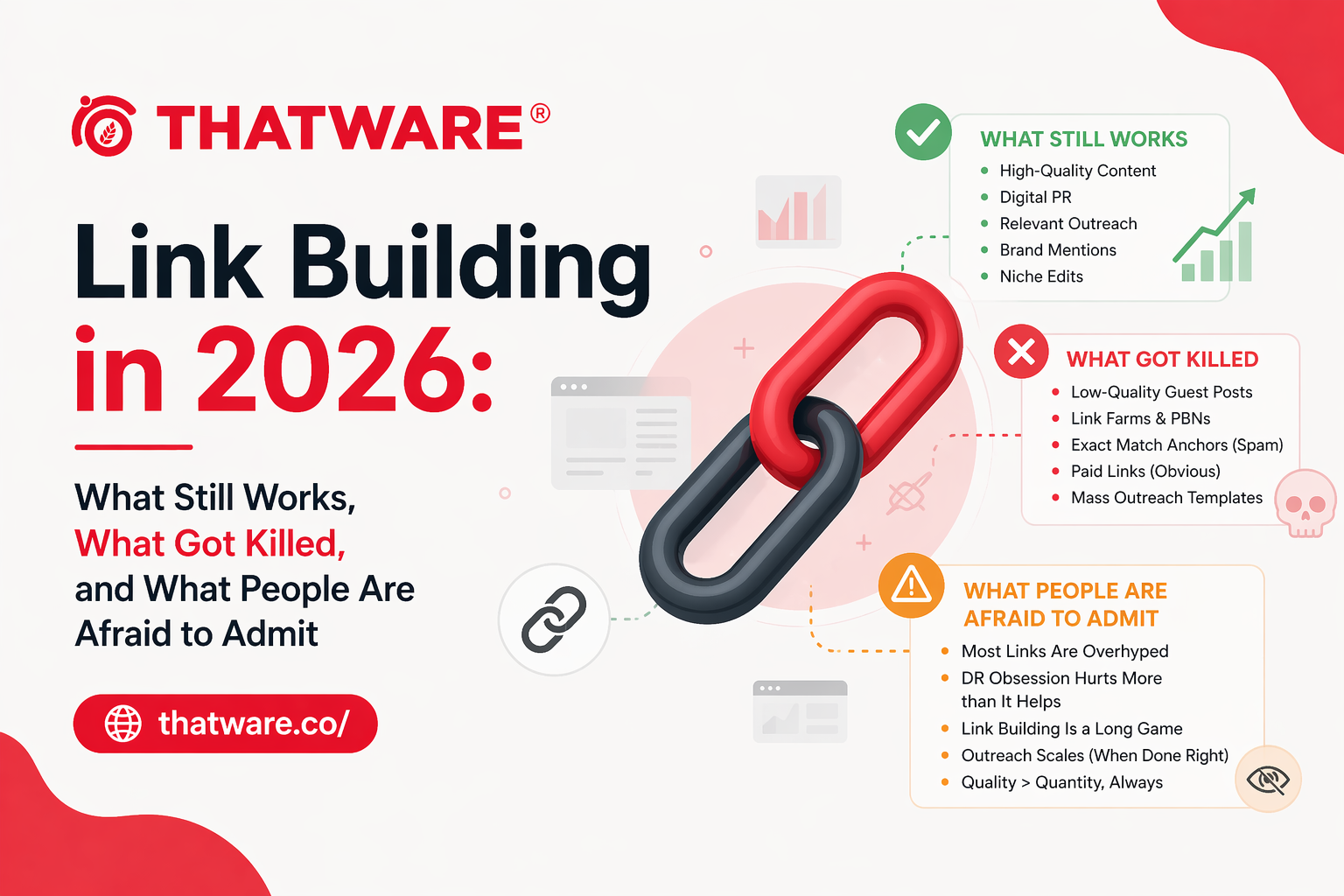
Link building has always been the part of SEO where the most creative approaches live right next to the most blatant manipulation. It’s a discipline where the gap between what agencies claim they do and what they actually do has historically been… considerable.
In 2026, the landscape has shifted meaningfully. Some things that used to work reliably have been killed by algorithmic and manual updates. Some things that used to be risky are now mainstream. And some fundamentals haven’t changed at all.
What Google Killed (or Severely Damaged)
Let’s start with the honest part. Several link building tactics that were widely practiced have been significantly devalued or penalized.
Private blog networks – networks of sites controlled by one entity, linking to each other for SEO benefit – have been targeted aggressively by Google’s spam systems. The sophistication of detection has improved significantly. Operating a PBN in 2026 is a considerably higher-risk proposition than it was five years ago.
Mass guest posting on low-quality sites, especially using scaled AI-generated content, has been explicitly targeted. The combination of algorithmic devaluation and manual action risk has made this a poor-risk-to-reward bet for most sites. Related: Convert Image to Video: Creative Ways to Repurpose Visual Assets
Paid links that pass PageRank without proper disclosure have been a technical violation of Google’s guidelines for years. The enforcement has gotten more consistent and the devaluation more reliable.
What Still Works
Digital PR – earning coverage and links from genuine journalists and publications through newsworthy content, original research, and expert commentary – remains one of the highest-ROI link building approaches available. The links it produces are exactly the kind Google is trying to reward: editorial, contextual, from authoritative publications that wrote about you because you had something worth writing about.
The challenge is that real digital PR requires real investment. You need genuinely interesting data, a compelling story, and the media relationships or pitching skill to get coverage. It’s not a volume play. But a handful of links from legitimate publications outperforms hundreds of links from low-quality guest post sites in terms of ranking impact.
link building services that lead with digital PR and content-driven authority building are operating at the legitimate end of the market. The ones leading with “we’ll get you 50 links this month” without explaining where they’re coming from deserve more scrutiny.
The Content That Earns Links Naturally
The most sustainable link building isn’t really link building in the traditional sense – it’s creating content that earns links because it’s genuinely useful, original, or interesting. Original research, comprehensive guides that go substantially beyond what already exists, tools and calculators, data visualizations, expert roundups built around real insight.
This requires a content investment, but the returns compound. A piece of content that earns links organically keeps earning them for years. A link campaign that stops when the budget stops, stops too.
What People Are Afraid to Admit
Here’s the uncomfortable truth that doesn’t get said enough: a significant portion of the SEO industry still practices link building methods that are technically against Google’s guidelines, at varying levels of risk. Not because they’re oblivious – but because those methods still work often enough to justify the risk in some competitive contexts.
The honest conversation about link building in 2026 involves acknowledging that risk spectrum rather than pretending everyone operates entirely in compliance. The relevant questions are: what’s the risk profile of the approach being used, what’s the expected return, and does that risk-reward calculation make sense for this specific site in this specific competitive context?
The Anchor Text Question
Anchor text – the clickable text in a link – remains a meaningful signal. Over-optimized anchor text profiles (heavy with exact-match keyword anchors) are a manipulation signal. Natural profiles are diverse, brand-heavy, and contextual.
seo link building services that promise a specific keyword anchor distribution are usually promising something that’s either undeliverable at scale or deliverable only through manipulative means. Natural-looking anchor diversity is a feature of good link building, not a compromise.
A Realistic Framework
For most businesses in 2026, a sensible link building strategy involves: building genuinely link-worthy content as the foundation, systematic digital PR outreach to relevant publications and journalists, strategic relationship building in their industry that produces natural editorial links, and opportunistic link recovery for broken links and unlinked mentions. That’s not exciting. But it works and it doesn’t carry the risk profile of the shortcuts.